
When a firm’s billing runs on discipline — when every hour worked moves through a defined cycle from work in progress to billed to collected — the financial picture becomes something operators can actually lead from. Partner compensation makes sense. Cash flow holds. The managing partner spends less time asking where the money is and more time deciding what to do with it.
That state is achievable. And for most firms, the distance between where they are and where they could be isn’t a collections problem. The gap opens earlier — between the work and the invoice — and it opens quietly.
The Leak Starts Before the Invoice Goes Out
Most revenue conversations in law firms center on collections: aging AR, payment terms, how long clients are taking to pay. Those are real concerns. But the realization leak that does the most cumulative damage happens upstream — before the client ever sees a number.
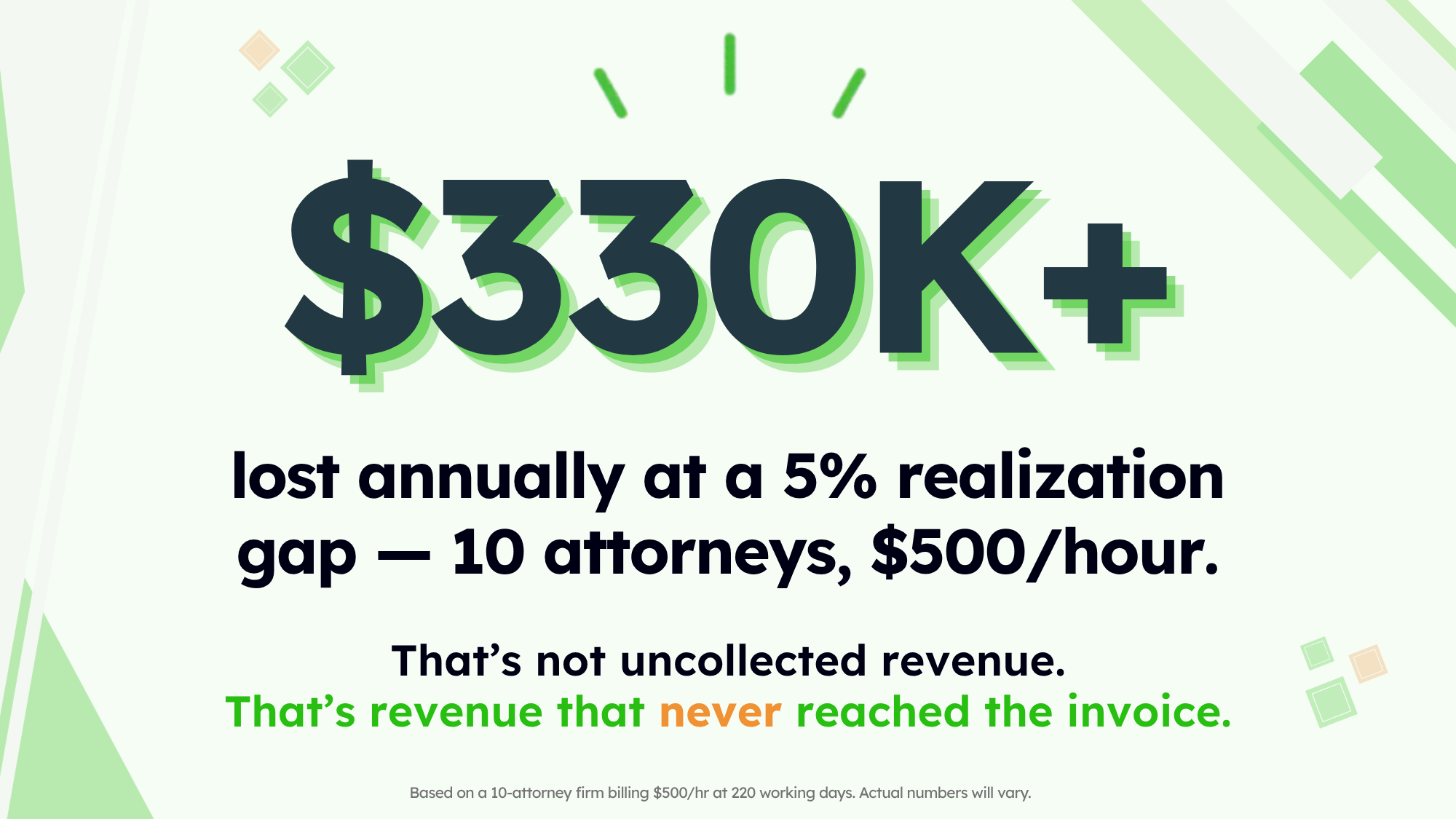
Firms commonly leave 5–8 points of realization on the table in the work-to-invoice stage alone. At a 10-attorney firm billing at $500/hour, a 5-point realization gap costs over $330,000 annually. That’s revenue the firm earned. Revenue that exists in the work record. Revenue that never made it to the invoice.
The question may seem to be: “Why aren’t clients paying faster?” But what you actually want to know is: “How much of what we billed actually reflects what we earned?”
Four Places Revenue Slips Before the Invoice Is Sent
The WIP lifecycle has four distinct points where revenue disappears — and none of them are visible without the right infrastructure.
1. Time that never gets captured
Time spent on a matter that doesn’t make it into the time entry system is the earliest and most permanent form of revenue loss. It can’t be billed, can’t be reviewed, and can’t be recovered. For attorneys logging time at the end of the day or reconstructing entries at week’s end, the gap between what happened and what got recorded is a daily margin leak.
2. Time captured but not billed
Unbilled WIP is the revenue that made it into the system — and then stalled. It accumulates across billing cycles when no one flags it before the window closes. By the time someone pulls an aging WIP report, some of it is weeks old, and the context for billing it accurately has started to fade. Clients notice when invoices arrive late or feel disconnected from the work — and that friction is its own downstream cost.
3. Write-downs that happen before the client sees the invoice
Pre-bill write-downs are among the least-examined sources of realization loss because they happen inside the firm before anything is sent. An attorney reviews the draft invoice, decides the time looks high, and reduces it — without any aggregate view of what that pattern is costing the practice. Across a billing cycle, across multiple timekeepers, those edits add up. The problem isn’t that write-downs ever happen; the problem is when they happen reflexively, without data, and no one is tracking the cumulative impact on realization rate.
4. Fixed-fee and contingency matters with no margin visibility
Every billing model carries its own margin risk. On fixed-fee matters, scope creep is the culprit — more hours worked than the fee supports, with no real-time signal until the matter closes. On contingency matters, time investment and case costs accumulate against an uncertain recovery, with visibility into profitability often arriving too late to change anything.
Contribute to Building Your Contingency Workflow
SettleFlow, LeanLaw’s model for contingency billing is currently in beta. Firms interested in early access — or in joining the waitlist for general availability — can request a demo or join the waitlist now. If you’re evaluating legal billing software for contingency fee work and want to see the settlement wizard, lien management workflow, and case closeout reporting in context, that’s the right starting point.
Why Month-End Reporting Doesn’t Catch This
The standard response to realization problems is better reporting. Run the WIP aging report. Pull the realization dashboard. Review write-downs at month-end.
The issue: by the time a billing report surfaces a problem, the damage is already done. The unbilled WIP has aged. The write-downs are posted. The matter may have closed. Month-end reporting tells firms what happened; it doesn’t give operators the ability to intervene while something can still be changed.
The underlying structural problem is that billing data, time data, and accounting data typically live in systems that don’t share a real-time view. Manual exports and reconciliation fill the gaps — when anyone has time to do them.
That’s not a reporting failure. It’s a Legal Revenue Operations gap — the kind that builds quietly and compounds across every billing cycle.
What Operational Command Over WIP Actually Looks Like
Firms that close this gap aren’t doing more manual work — they’ve built a billing operating model where the workflow itself enforces the discipline.
Real-time WIP visibility means knowing what’s unbilled by matter and timekeeper before it ages past the point of clean billing. That’s not a reporting feature; it’s a structural change in when information arrives.
Write-down tracking at the aggregate level surfaces patterns: which billing models are generating the most pre-bill edits, which matters are consistently over budget, which timekeepers are discounting before the client ever asks. That data belongs in a managing partner’s hands — not reconstructed quarterly, but visible in the normal course of operations.
For fixed-fee matters, tracking time logged against the fee in real time gives billing admins and firm administrators a signal they can act on: which matters are running long, where scope is drifting, and when a client conversation about fees is warranted before the matter closes at a loss.
And when invoice review moves through a defined, connected workflow rather than a series of individual decisions and manual handoffs, billing discipline becomes a system property — not something that depends on who’s paying attention that week.
The downstream effect is worth naming directly: when invoices are accurate, timely, and built from a complete record of the work, clients receive something different — a clearer statement of value, a more professional interaction, and fewer billing disputes. That matters to managing partners who think about firm reputation and retention alongside realization rates. Operational discipline over WIP isn’t just a collections accelerator; it’s part of how a firm signals competence to the clients it wants to keep.
The Full Lifecycle Starts Here
Work in progress → billed → collected. The handoff this post addresses is the first one — and it’s where the foundation for everything downstream is either built or compromised.
Firms that arrive at the billing stage with complete, reviewed, accurately-priced WIP enter collections in a different position: tighter cycles, cleaner invoices, less revenue already written off before the client pays. The realization conversation shifts from “how much did we lose?” to “here’s what we earned, here’s what we billed, here’s what’s on its way.”
That’s what Legal Revenue Operations makes possible — not as a destination, but as a daily operating reality. The firms that get there have stopped treating the work-to-invoice gap as a billing problem and started treating it as what it actually is: a structural question about how revenue moves through the business.

Written by
Rachel Bondurant
Head of Brand and Content
Rachel Bondurant leads brand and content at LeanLaw, where she writes about legal billing, trust accounting, and the financial operations of modern law firms. Her work translates the realities of law-firm finance — billing workflows, IOLTA and trust compliance, and revenue leakage — into practical guidance for attorneys, firm administrators, and the accountants who support them.
Related articles