Firms don't need more billing tools. They need one revenue experience.
The gap between what your firm earns and what it collects starts where your systems stop talking to each other. LeanLaw closes it.
1,000+
Law Firms
70%
Faster Collections
100%
Trust Compliance
Revenue Command Center
Live$842K
Work Performed
$781K
Billed
$612K
Collected
Realization
91%
Collection Rate
88%
Days-to-Collect
34 days
Lockup Exposure
$128K
Law firms have more tools than they've ever had. Realization is still leaking. The reason is structural: billing that doesn't sync to accounting, reporting that arrives too late to act on, and manual work filling the gaps nobody designed out. LeanLaw is built for the full lifecycle — because closing the gap requires owning the whole thing.
Three outcomes. One revenue experience.
Turn every billable moment into collected revenue.
The revenue lifecycle has four stages where it breaks — intake, time capture, billing, and collections. Each billing model carries its own margin risk: eroding realization on hourly matters, scope creep on fixed-fee, cash volatility on contingent.
LeanLaw tracks every dollar from work performed to cash collected, across all three. Which matters are profitable. Which are eroding. Visible before it's too late to act — not reconstructed after it's too late to fix.
Matter Profitability · By Billing Model
- Hartley Estate Hourly92%
- Corso Build-Out Flat Fee74%
- Renn v. Atlas Contingency58%
- Doyle Litigation Eroding−12%
See your financial data in real time
Realization, collection rate, days-to-collect, and lockup exposure — in real time, across every matter and every timekeeper. Not exported to a spreadsheet. Not reconstructed at month-end. Live, because the only financial data you can act on is the data that's current. When a collections month starts slow, you'll know in week one — not week four.
Connect every system. Control the full picture.
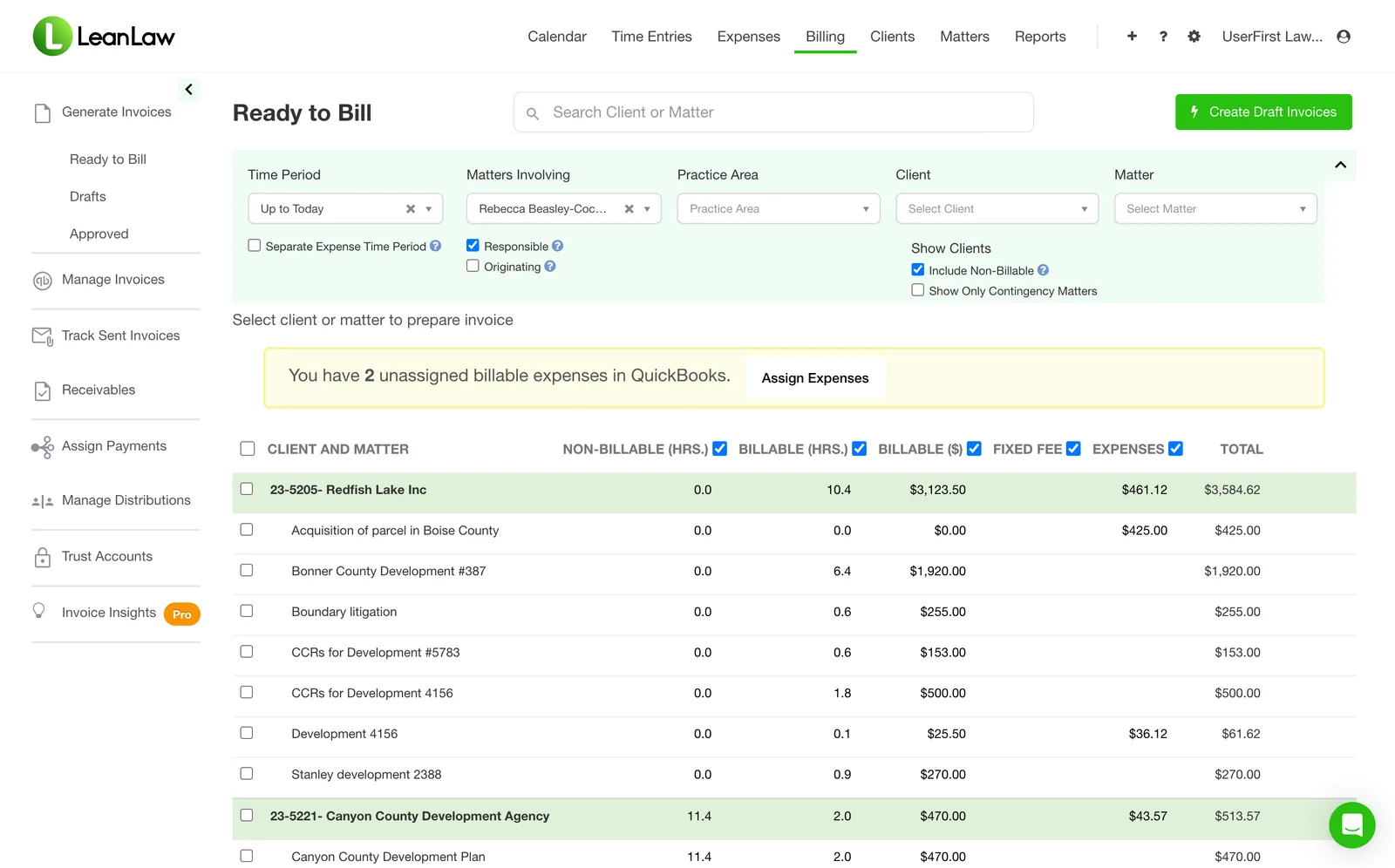
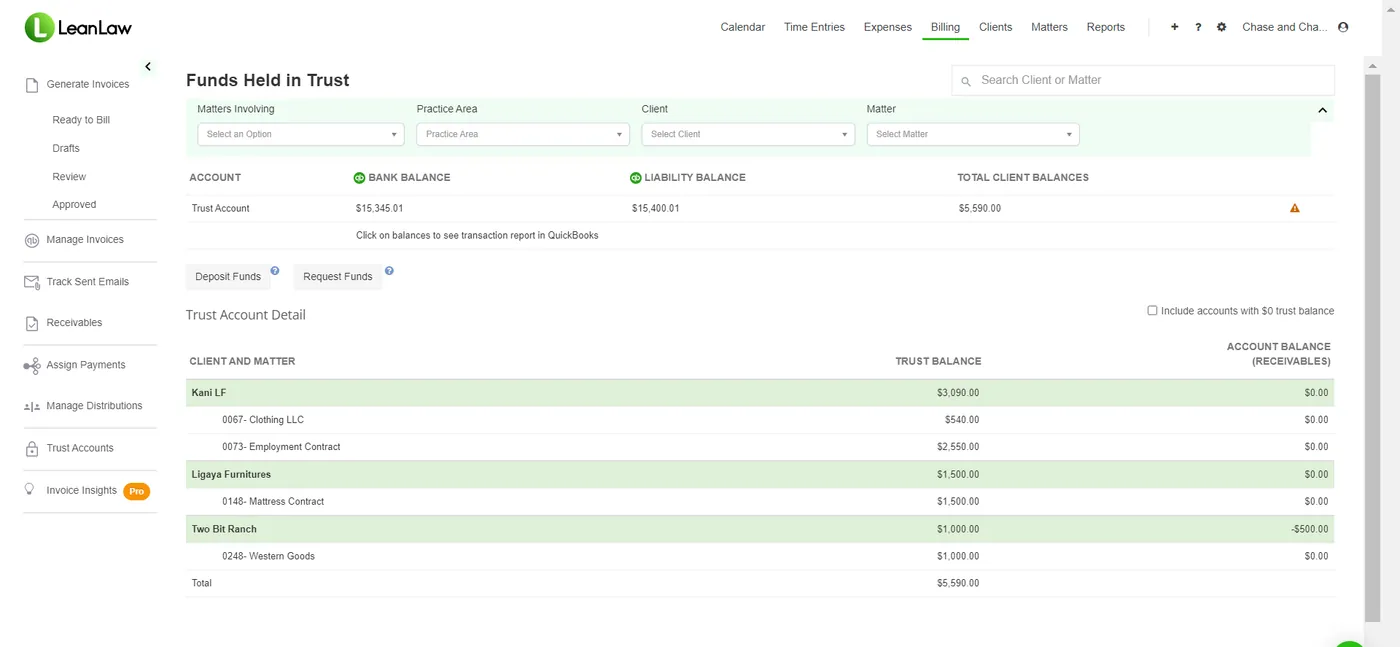
LeanLaw doesn't replace the tools your firm already uses. It connects them into one revenue experience — so billing, payments, accounting, and reporting work as a single workflow, not a series of handoffs. Native QuickBooks Online sync as the financial source of truth. Trust accounting built in, not bolted on. Billing discipline enforced at the system level.
Work performed. Billed. Collected. That's the whole job.
Every dollar your firm earns moves through a lifecycle. At every handoff, there's a place where revenue can stall. Most firms patch those places manually. LeanLaw connects them structurally — so the work your attorneys do moves to the cash your firm can count on.
Intake & Retainers
The relationship starts clean: retainer terms, billing model, and trust funding captured once — and carried forward automatically.
Time Capture
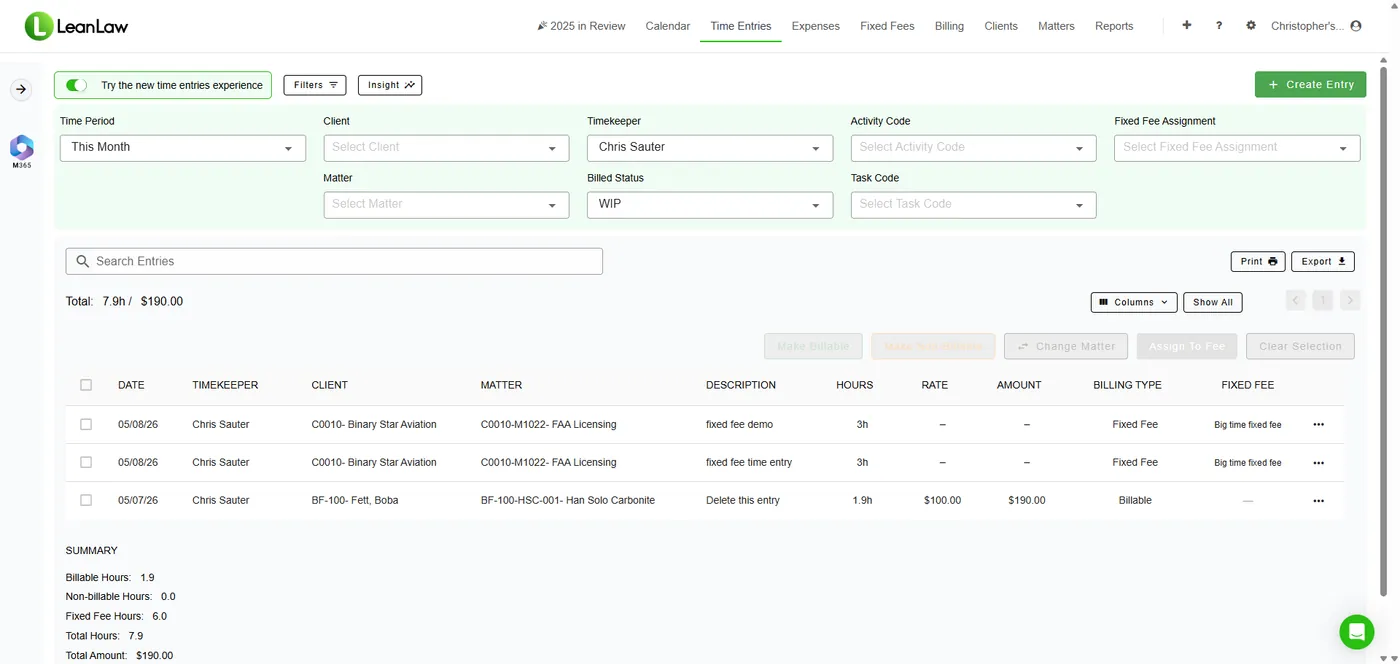
Time is recorded where the work happens, tagged to the matter and billing model — so nothing has to be reconstructed at invoicing.
Billing & Invoicing
Invoices generate from the same connected record — hourly, flat fee, or contingency — with discipline enforced at the system level.
Collections & Payments
Payments link back to the invoice and the matter automatically — so collection rate and days-to-collect stay current, not estimated.
Reporting & Visibility
Realization, lockup, and matter profitability roll up live — visible to the people who need to act on it, when they need to act.
Hourly. Flat fee. Contingency. LeanLaw tracks all three.
Walters Gilbreath, PLLC
300+ invoices sent monthly. Billing inquiries down to near zero.
Walters Gilbreath was fielding billing questions from 10–15% of its 300–350 monthly invoice recipients. After implementing LeanLaw's invoice delivery and account-summary workflow, client billing inquiries dropped to near zero — redirecting that capacity toward recovering outstanding receivables.
Read the full storyPursuit Legal
50% less time on invoicing. $13K recovered in 30 days.
Pursuit Legal was spending significant staff time on monthly invoicing while past-due balances accumulated. After connecting billing and collections through LeanLaw, invoicing time dropped by half — and full-balance payment links brought in $13,000 in overdue receivables within the first month.
Read the full storyBarros, McNamara, Malkiewicz & Taylor, P.A.
Billing cycle: one week down to two hours.
A billing cycle that consumed a full week of staff time every month now takes two hours. The shift was significant enough to move the bookkeeper role from full-time to part-time — overhead that went straight back to the firm's bottom line.
Read the full storyPartner compensation should be a calculation, not a conversation.
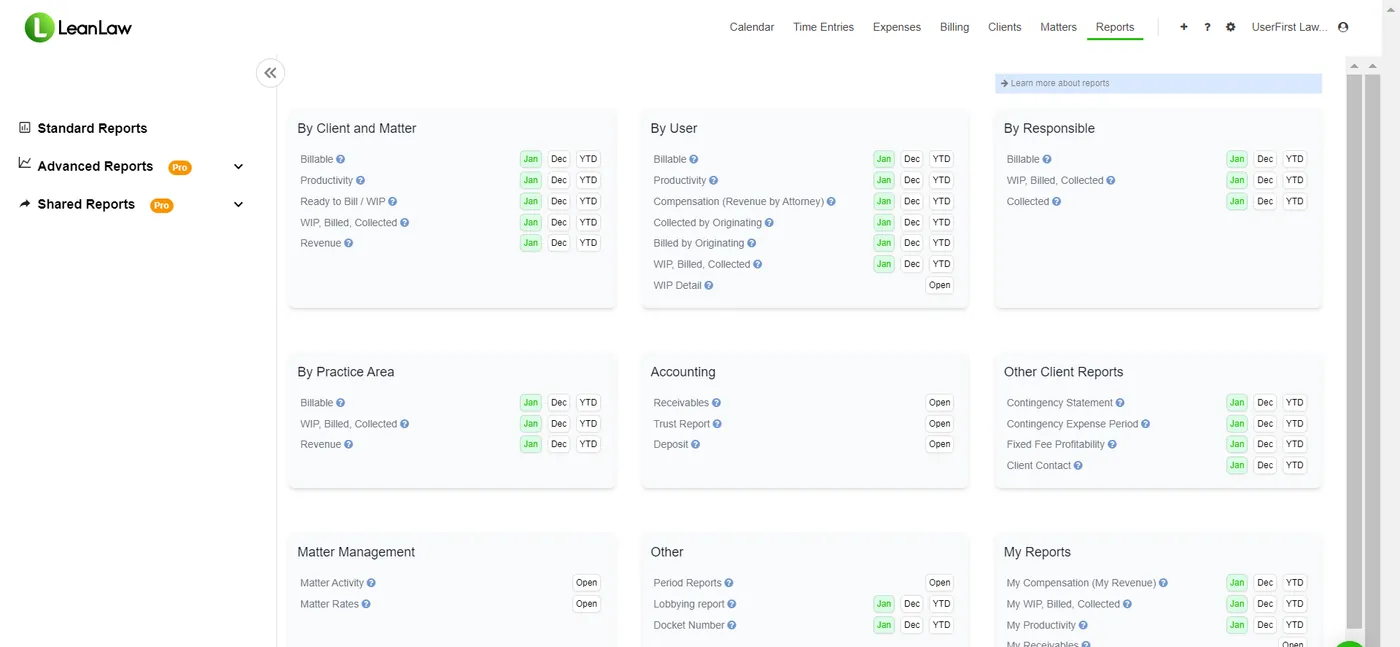
LeanLaw surfaces origination, realization, and collection performance in real time — by matter, by timekeeper, by billing model. Distributions become deliberate, not estimated. The firm's financial position is visible before it becomes a problem to solve.
The managing partner who knows their realization rate, lockup exposure, and days-to-collect — before month-end — is running a different firm than the one who finds out after.
Firm oversight shouldn't mean chasing five people for one number.
LeanLaw gives firm administrators real-time visibility into billing, collections, and matter-level performance — without waiting on month-end reports or calling the bookkeeper.
Invoice day drops from eight hours of work to two. The administrator who can see realization and collections in one place — live — runs billing as a system, not a monthly scramble.
Every billable minute should make it onto an invoice.
LeanLaw makes it effortless to log time from any device the moment work happens — mobile, desktop, or calendar integration — so nothing gets reconstructed from memory at month-end.
The timekeeper who captures time as it happens — not two weeks later — is why the average LeanLaw firm recovers $61K per attorney per year in previously leaked billable time.
Partner Distribution
$214K Origination YTD
91%
Realization
88%
Collection Rate
34 days
Days-to-Collect
Firm Revenue
$781K Billed YTD
92%
Hartley Estate
74%
Corso Build-Out
58%
Renn v. Atlas
Time Capture
$61K Recovered / Attorney / Yr
$842K
Work Performed
$781K
Billed
$612K
Collected
Live in weeks. Fluent for good.
Plan
Kickoff, timeline, and a setup mapped to your firm. Operating-model fit confirmed, roles assigned.
Connect
QuickBooks Online integration, data migration, chart-of-accounts review. Your financial source of truth, live.
Launch
Your first real invoice goes out, with a dedicated specialist on call. The billing workflow, proven end to end.
Adopt
Fully institutionalized after three billing cycles. Team fluent, workflows owned, support ongoing.
Three onboarding tracks — Quickstart, Premium, and Premium + Bootcamp — scaled to your firm's size and complexity. Same rigor. Different depth.
The things most software companies wait for you to discover.
On QuickBooks Online
LeanLaw requires QuickBooks Online — not as an integration, but as the financial source of truth. If your firm is on QuickBooks Desktop, a different accounting system, or no accounting system, LeanLaw is not the right fit today. We'd rather you know that now than after an hour-long demo.
On Migration
Migration is the objection that ends more evaluations than any feature gap. The honest version: there's real work involved. It's structured, scoped to your firm, and handled with you — not handed off. We don't disappear after you sign.
On Complex Billing
IOLTA trust accounting, LEDES billing, contingency-fee work, split billing — those aren't workarounds we've built in. They're the foundation LeanLaw was built on. If you have specific requirements, ask us to walk through your exact workflow before you decide.
On Why We're Saying All This
Operators with sharp BS detectors — which describes most of the people reading this — trust companies that name constraints before they're asked. That's how LeanLaw operates: internally, with customers, and here.
Frequently asked questions
What is LeanLaw?
LeanLaw is legal billing and accounting software built natively on QuickBooks Online. It runs the full revenue lifecycle for law firms — time tracking, billing, trust accounting, payments, and real-time reporting — across hourly, flat-fee, and contingency matters.
How is LeanLaw different from Clio?
Clio is built for case management — billing and accounting are secondary features. LeanLaw is purpose-built around QuickBooks Online as the general ledger, so every invoice, payment, and trust transaction posts to your books in real time with no double entry. Firms that switch from Clio Manage + Clio Payments typically recover the $8–10K/year they were losing to billing gaps and manual reconciliation.
How much revenue do firms typically recover after switching?
The average LeanLaw firm recovers $61,000 per attorney per year in previously leaked billable time — primarily from hours that were worked but never recorded. On top of that, firms collect invoices 70% faster because clients can pay online the moment they receive them. Most customers see 20–50x ROI within the first year.
Do I need to change my accounting software to use LeanLaw?
Only if you are not already on QuickBooks Online. LeanLaw is built natively on QBO and requires an active subscription. This is by design: rather than maintaining a separate general ledger with a risky export step, every billing event syncs to QuickBooks the moment it happens. Your bookkeeper never leaves the accounting system they already know.
How long does it take to get started?
Most firms are billing live in LeanLaw within five to ten business days. The LeanLaw team handles data migration from your prior system, connects your QuickBooks Online account, and trains attorneys, billing staff, and bookkeepers before go-live. Many firms send their first invoice the same week they start onboarding.