
Key Takeaways:
- Hourly-billing firms aren’t losing revenue because they’re not working hard enough. They’re losing it because the dollar lifecycle was never built to capture everything they’ve earned.
- Visibility is not governance. One tells you where the leak is. The other closes it.
- The top 100 LeanLaw firms collect 99% of what they invoice and realize 90% of what they bill — beating industry benchmarks on both metrics, without working more hours.
The revenue an hourly-billing firm earns and the revenue it actually collects are rarely the same number. Most firms know this. Fewer know exactly where the gap lives — or that it starts well before an invoice goes out.
Industry data maps what researchers call “the lawyer’s funnel” — and the losses are significant. The average attorney records only 3 billable hours out of an 8-hour day. Of those recorded hours, firms bill roughly 88% after write-downs and collect 93% of what they invoice. Run the math end to end: a typical attorney is collecting for about 2.4 hours of an 8-hour day. That’s a 70% revenue gap on time that was already worked.
The gap is structural: a revenue capture problem, not a productivity one. A revenue leakage audit maps exactly where in the lifecycle those dollars fall out — from unrecorded time to write-downs to uncollected invoices.
What Is Realization Rate, and Why Does It Matter?
Realization rate is the percentage of billed work that becomes collected revenue. It’s one of three metrics — alongside collection rate and days to collect — that determine whether a firm’s financial performance reflects the work its attorneys actually did. Most firms track these numbers. Fewer understand where in the dollar lifecycle (work performed to cash in the bank) the losses are occurring, or why.
The answer comes from four smaller leaks, compounding at every stage.
The Four Stages Where Hourly Billing Revenue Leaks
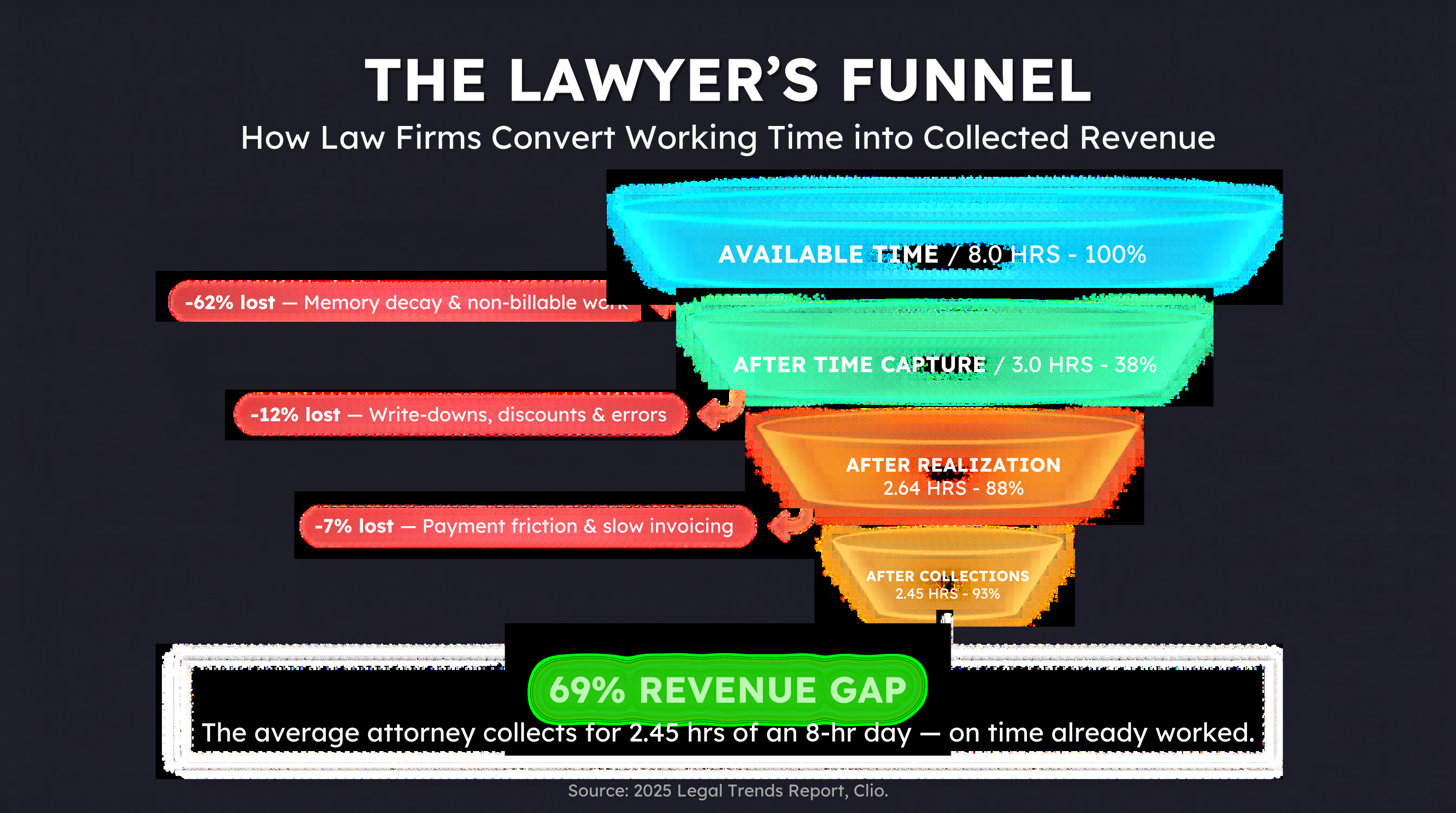
Stage 1: Time capture. The average firm records 38% of available time. Memory decay accounts for a significant share of the gap: attorneys who reconstruct time at end-of-week lose 15–25% of what they actually worked, even after logging it. For a single attorney billing at $300/hour, that’s $48K–$96K in lost revenue per year — before a single invoice goes out. Moving from weekly reconstruction to same-day entry drops that loss from roughly 20% to near zero.
Stage 2: The billing cycle. The average firm takes a full week each month to produce invoices. That lag delays cash flow by six or more days and creates the conditions for billing errors, unnecessary write-downs, and invoice disputes that wouldn’t exist if invoices went out while the work was still fresh. Billable hours performed but not yet invoiced represents real revenue at real risk of never being collected.
Stage 3: Realization. Write-downs, discounts, and billing errors reduce billed revenue to roughly 88% of recorded time. Some write-downs are intentional client management. Many aren’t — they’re billing friction that accumulates when invoice review is manual, error-prone, and slow.
Stage 4: Collections. Payment friction leaves another 7% of billed work uncollected. PDF invoices with instructions to mail a check aren’t a payment experience — they’re an obstacle. Sixty-five percent of legal clients prefer to pay electronically, yet most firms haven’t built a path for them to do it. Industry data from 2025 confirms AR aging is increasing as clients slow payment on paper invoices.
For a 10-attorney firm billing at $300/hour, these four leaks compound to more than $4 million in available revenue that never reaches the bank. The average firm collects $1.87M of $6M in available time — 31 cents per available dollar.
LeanLaw surfaces all four of these metrics in real time — utilization, realization, collection rate, and days to collect.
Why Better Reporting Doesn’t Close the Gap
The instinct when revenue is leaking is to get more visibility — sharper dashboards, better reports, more granular data. That instinct is understandable, and incomplete.
Visibility tells you where the leaks are; it doesn’t close them.
Practice management tools track activity. Legal Revenue Operations governs financial outcomes. The firms that actually improve realization and collection rates aren’t the ones with the best reports — they’re the ones with connected workflows: systems where billing discipline is enforced at the process level, not left to individual behavior. Individual behavior, no matter how capable the people, produces inconsistent results. Connected workflows produce consistent ones.
This is the distinction between billing software and Legal RevOps: billing software records what happened, and a connected revenue lifecycle system determines what happens next — from time captured to cash collected, at every stage.
What Effective Revenue Operations Look Like in Practice
For hourly-based firms, billing workflow effectiveness shows up at five specific points between work performed and cash collected.
Same-day time capture. Moving attorneys from weekly reconstruction to same-day entry requires more than asking them to change habits — it requires making entry low-friction enough that it actually happens. Three-tier capture (manual timers, calendar conversion, and Billables.ai, which passively captures billable activity in the background and surfaces it for attorney review) addresses the behavior, not just the expectation. The outcome is more accurate time recorded; fewer write-downs downstream and less unbilled WIP follow from that.
Structured invoice workflows with forward-only logic. When invoice production is governed by a defined workflow — work in progress to draft to approved to sent — billing cycles compress and errors surface before the invoice leaves the firm. The key mechanism: a billing administrator should be able to manage write-downs, matter reassignments, and credits without sending the invoice backward in the workflow. That’s what separates a governed billing process from a manual one. One firm cut invoice production from a full week to a single day. Another reduced client billing inquiries from 10-15% per month to near zero by including account summaries and trust balances directly on the invoice.
Everything the client needs to pay, in a single send. One email: invoice, full account balance, trust balance, retainer summary, and a payment button. Not just a payment link — the entire financial relationship in a single communication. That’s what drives cash velocity and shortens days to collect. A 5-point improvement in collection rate isn’t a rounding error: for a firm billing $8 million annually, it’s $400,000 in recovered revenue.
Trust management anchored to your accounting system. Trust reconciliation errors create audit risk and partner anxiety in equal measure. When trust workflows run through QuickBooks Online sub-ledgers — with LeanLaw explicitly separating accounting entry creation from real-world bank movements — three-way reconciliation becomes a system output, not a manual task. That separation is intentional: it prevents the system from making assumptions about fund movements that carry personal bar liability. Firms running this way cut trust management time by as much as 50% and eliminate a category of risk that has no upside.
Real-time performance visibility, down to the matter level. Discipline without visibility is enforcement without accountability. LeanLaw surfaces realization rate, collection rate, days to collect, and aging WIP and AR in real time — not reconstructed at month-end — so the people accountable for financial performance can see where the dollar lifecycle is breaking down before it compounds. Views can be custom-configured by matter, by timekeeper, and by practice area; for firms where the responsible attorney model drives billing decisions, that granularity is what makes the data actionable rather than informational.
The Cumulative Case
These five improvements compound. Better time capture means less unbilled WIP. Less unbilled WIP means more accurate invoices. More accurate invoices mean fewer write-downs. Fewer write-downs improve realization. Faster payment collection improves cash velocity. Governed trust accounting reduces compliance overhead. And real-time performance visibility gives the people accountable for all of it a clear view of where the dollar lifecycle is holding — and where it isn’t.

The top 100 LeanLaw firms collect 99% of what they invoice and realize 90% of what they bill — beating both Clio benchmarks, without working more hours. The revenue was already being generated. It was being lost before it reached the bank.
This is what financial clarity looks like for a law firm in practice: not better forecasting, but tighter operational control. When Legal RevOps connects cleanly at every stage, revenue stops being something you reconstruct at month-end and starts being something you can count on.
A Note on Fit
One thing worth naming before you go further: LeanLaw requires QuickBooks Online. If your firm runs on QuickBooks Desktop or another accounting platform, LeanLaw isn’t the right fit at this time.
For firms on QuickBooks Online, that foundation is what makes the Legal RevOps model work. LeanLaw is built on QuickBooks Online — not as an integration, but as the accounting source of truth. Bookkeepers work where they already work. Trust reconciles where everything else reconciles. There’s no duplicate accounting system, no manual export, no gap between what billing shows and what the books confirm. LeanLaw centralizes control over your entire revenue lifecycle — time capture, invoice production, payment collection, and trust management — without requiring you to replace your accounting system or maintain two sets of books.
Frequently Asked Questions
Does LeanLaw work with my current accounting software?
LeanLaw is built on QuickBooks Online — not as an integration, but as the accounting source of truth. That’s worth naming directly: LeanLaw requires QuickBooks Online. If your firm runs on QuickBooks Desktop or another accounting platform, LeanLaw isn’t the right fit at this time. For firms on QuickBooks Online, that foundation is what makes Legal Revenue Operations with LeanLaw work — there’s no duplicate accounting system, no manual export, and no gap between what billing shows and what the books confirm. Your bookkeeper never has to leave QuickBooks Online.
How is LeanLaw different from the practice management software we already use?
Practice management platforms — Clio, MyCase, and others — handle intake, matter management, and workflow. LeanLaw doesn’t compete with those tools and doesn’t replace them. What it governs is the revenue lifecycle those platforms weren’t built to close: the gap between work performed and cash collected. If your practice management system is where your matters live, LeanLaw is where your dollars are governed. For many firms, they run alongside each other without conflict.
What does migration actually look like — do we have to rebuild everything?
Migration is the most common reason firms delay, so it’s worth addressing plainly. Because LeanLaw is built on QuickBooks Online rather than replacing it, your existing accounting data structure stays intact. Onboarding is structured around your operating model — your billing workflows, your trust setup, your QuickBooks Online configuration — not a generic implementation playbook. The process includes QuickBooks Online setup and trust mapping, handled with you, not handed off to you after you’ve signed.
We already track realization and collections in our current system. What does LeanLaw add?
Visibility and governance are different problems. Most firms can tell you their realization rate at month-end — LeanLaw surfaces it in real time, so the people accountable for those numbers can act before the month is already lost. More importantly, LeanLaw doesn’t just report on where revenue is leaking; it governs the workflows that close the leak. Governed invoice workflows, embedded payment collection, and structured trust management change the outcomes — not just the reporting on them.
How quickly do firms typically see results?
It depends on which part of the revenue lifecycle you’re tightening first. Firms that implement embedded payment collection have seen results within the first billing cycle; billing cycle compression tends to show up quickly too. Realization improvements take slightly longer to measure, since they compound across billing periods — but the conditions for improvement (governed write-down discipline, same-day time capture) are in place from day one.

Written by
Rachel Bondurant
Head of Brand and Content
Rachel Bondurant leads brand and content at LeanLaw, where she writes about legal billing, trust accounting, and the financial operations of modern law firms. Her work translates the realities of law-firm finance — billing workflows, IOLTA and trust compliance, and revenue leakage — into practical guidance for attorneys, firm administrators, and the accountants who support them.
Related articles