
Legal practice management software helps a firm organize matters, deadlines, documents, client work, and sometimes billing. To choose an approach, identify which of those workflows needs a new owner, then test how time, invoices, trust activity, and accounting move between systems. A full suite may cover both cases and finances, while a practice-management system paired with connected billing and accounting tools can keep each job in a separate product. LeanLaw handles time and expense tracking, legal billing, trust accounting, and reporting on QuickBooks Online; it is not a full practice-management system.
For attorneys evaluating law practice management software, start with the tasks and handoffs that cause problems today. The table below separates full suites, billing-first tools, and standalone time and invoice apps so you can test the right category before comparing vendors.
What Does Legal Practice Management Software Do? Selection Criteria Key Capabilities to Evaluate Essential Tasks for Any Successful Law Firm LeanLaw: A Focused Alternative for Billing and Accounting
Though technology can make your days more efficient and your work more accurate, not all technology is created equal.
Sometimes, too much of a seemingly good thing can end up causing more harm than good.
Such is the case with many of the more popular legal practice management software systems in use by law firms today.
What Does Legal Practice Management Software Do?
Practice management software for lawyers is a suite of digital tools designed to help law firms run their day-to-day operations. Core capabilities typically include:
- Matter and case management — tracking case status, deadlines, and documents for every matter
- Time and expense tracking — capturing billable hours in real time from any device
- Legal billing and invoicing — generating accurate invoices, supporting LEDES formats, and handling split billing
- Trust accounting — managing client funds in compliance with state bar IOLTA rules
- Client and contact management — maintaining a searchable record of clients, opposing counsel, and contacts
- Document management — storing and retrieving case files securely
- Reporting and analytics — tracking firm profitability, attorney productivity, and realization rates
Some platforms try to cover all of these in a single all-in-one system. Others are built to specialize in one area and integrate cleanly with best-in-class tools for the rest.
Choosing an approach: suite, billing-first, or standalone
| Approach | Primary job | What to check | Where LeanLaw fits |
|---|---|---|---|
| All-in-one practice-management suite | Run cases, intake, documents, calendars, and often billing in one product | Whether its billing, trust, and accounting workflow meets the firm’s needs | LeanLaw is not this category |
| Practice management plus connected billing and accounting | Keep case work in a practice system and connect a separate financial workflow | Which records sync, who resolves errors, and where the general ledger lives | LeanLaw features show a billing workflow on QuickBooks Online that can sit alongside case tools |
| Standalone time and invoicing tool | Capture work and issue bills | How client trust, payments, reporting, and the general ledger are handled | Useful for narrower needs; compare the whole financial workflow before choosing |
Selection criteria for legal practice management software
Start with the work that must happen in one system and the work that can cross a handoff. Use the same sample matter to check each option against these criteria:
- Matter work: Can the people responsible for intake, deadlines, documents, and communication find the information they need?
- Financial path: Follow a time entry through approval, invoice, payment, trust activity if applicable, and the accounting record. Note every manual step.
- Ownership and controls: Identify who may edit a matter, approve a bill, move client funds, and correct a sync error.
- Implementation: Ask what data can be imported or exported, who will train each user group, and what happens to existing tools.
- Total cost: Compare the products, required connections, onboarding, and ongoing administration for the workflow you actually need.
For hosting, access, backup, and migration questions, use the cloud legal practice management guide. To turn these criteria into a firm-size shortlist and repeatable demos, see how to choose practice management software.
What should legal practice management software cover?
Start with the work your firm needs the software to own. A full practice-management system usually covers case files, deadlines, intake, documents, and communication as well as billing. A billing-first platform covers a narrower financial path: record work by matter, review and send invoices, accept payments, manage client trust, and understand what was billed and collected. A standalone timer or invoicing app may address one step without covering the whole path.
Write down who does each step today: attorney, billing staff, bookkeeper, and partner. Then test the handoffs with a sample matter. If a case-management tool already handles legal work well, LeanLaw’s features show how to assess the financial side without assuming every workflow must move into one suite.
Can a billing-first platform be part of a legal practice-management stack?
Yes. A firm can keep a separate case and document system and use LeanLaw for time, billing, trust accounting, and reporting on QuickBooks Online. That setup works when the firm is comfortable assigning different tools different jobs and checking the handoff between them. It does not make LeanLaw a full case-management system.
Ask to see one matter through time entry, invoice approval, payment, and the resulting QuickBooks Online record. If your firm holds client funds, include the trust ledger and reconciliation reports. Review the product features or walk through the workflow in a demo with the people who will use it.
Key Capabilities to Evaluate
When comparing practice management software for attorneys, focus on these criteria:
- QuickBooks Online integration — if your firm already uses QBO for accounting, look for software that connects natively rather than requiring a separate ledger
- Trust accounting compliance — the software should enforce three-way reconciliation and generate the reports your state bar requires
- Billing accuracy — time captured should flow directly to invoices without manual re-entry
- Mobile access — attorneys need to log time from anywhere, not just at their desks
- Ease of adoption — complex systems that require months of retraining often go underused
- Transparent pricing — predictable per-user pricing makes budgeting straightforward; see LeanLaw pricing
- Integration flexibility — can it connect with your existing document management, CRM, or email tools?
All-in-One vs. Billing-First Practice Operations
The choice is not simply “more features” versus “fewer features.” It is a choice about where the firm wants its operational center of gravity. A full practice-management suite can centralize case work, while a billing-first stack can keep case and document tools in place and specialize the financial workflow.
| Decision area | Full practice-management suite | Billing-first financial layer |
|---|---|---|
| Primary job | Coordinate cases, intake, documents, calendars, and billing | Connect time, invoices, payments, trust, and accounting |
| Case management | Usually a core capability | Remains in a separate case-management tool |
| Accounting | Built in or connected; depth varies by product and plan | Uses a dedicated accounting system such as QuickBooks Online |
| Trust workflow | Often included; reconciliation workflow varies | Evaluated as part of the billing and accounting process |
| Best fit | Firms replacing several operational systems at once | Firms whose case tools work but billing and books need attention |
LeanLaw fits the second category. It is not full case-management software; it is a billing-first financial platform for law firms using QuickBooks Online. Compare the financial workflow in the best legal billing software guide, or review a broader legal practice management software comparison.
IOLTA Trust Accounting for Attorneys and Law Firms

Practice management software for lawyers often promises to streamline every workflow and simplify every operation — but this is not always the case.
For many law firms, certain best practices are already in place that do not need to change.
In fact, sometimes forcing “improvements” into areas that are already working creates more frustration than value.
When thinking about what is best, focus on your firm specifically.
What type of software is actually going to suit your firm?
Will it be an all-in-one practice management solution that requires retraining every attorney and staff member while transferring thousands of documents?
Or will it be software designed to integrate with tools you already use — like Microsoft 365 or QuickBooks Online — into a platform built around your firm’s specific needs?
These decisions are not easy. Start from a simple baseline.
Whatever system you choose, think about what you already have that is working and what you could improve.
Often, what is already working is more than you realize.

What Are the Essential Tasks for any Successful Law Firm?
Before deciding whether your firm needs new legal practice management software, answer this:
Which tasks are you managing successfully today, and which ones need real improvement?
Defining where your firm is already working well is just as important as identifying the gaps. There is no point in paying for a practice management software legal system that forces changes in areas that are already running smoothly.
On the other hand, there may be areas where modern software will make an enormous difference once implemented correctly.
Certain technology can also improve efficiency, accuracy, and transparency in ways that help a law firm stay in compliance with state and federal rules.
Let’s look at the tasks most firms need to address.
1. Client Communication
Client communication is one of the bedrock functions of any successful law firm.
But the ways attorneys and staff communicate with clients have changed significantly.
Thanks to technology, the modes of client communication have grown: in-person, teleconference, phone, and email. This is generally good news — it makes communication more efficient and cost-effective.
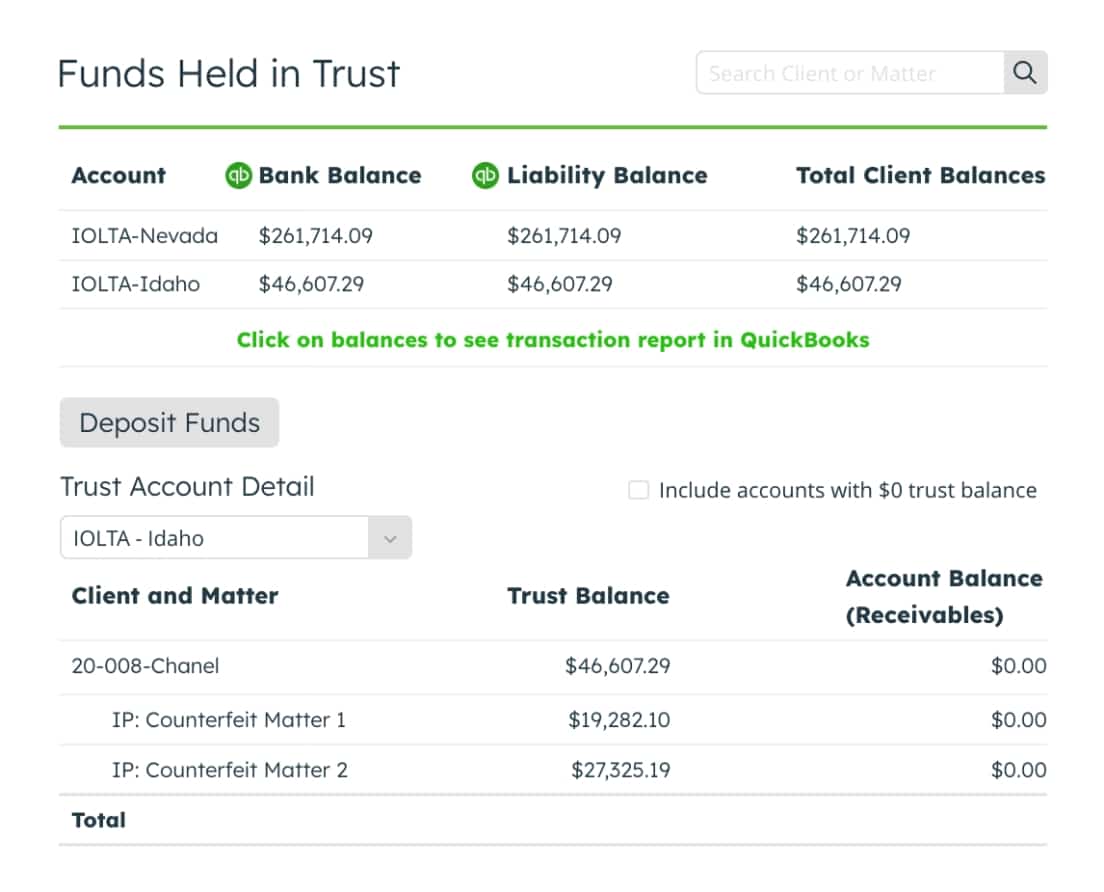

IOLTA inflow and outflow accountability
Request and track IOLTA funds electronically with integrated payments. Better understand how funds are flowing in and out of trust and bank accounts with convenient, clear reporting. Realize higher accounts receivable. And use memos to communicate transparently with clients.
If you already have a proven email workflow in your practice, you do not need to pay for a practice management system just to replace it.
Many law practice management software vendors advertise improved client communication as a core feature. Evaluate honestly whether that is a gap you actually have before paying for it.

2. Document Management
Document management is critical to any reputable law firm. Client files require high security and consistent organization.
If your document storage is already working well — whether through NetDocuments, Dropbox, OneDrive, or Google Drive — there is no reason to replace it with a built-in feature inside a heavier practice management platform.
Many firms that purchase all-in-one software for its document management feature report that they never fully migrate their existing files. The complexity of the transfer process makes the feature effectively unused.
All-in-One Legal Accounting Features
Explore all the other features the LeanLaw financial operating system offers to streamline your legal operations and reduce the workload on your team of legal professionals:
Timekeeping and Expense Tracking

3. Time and Expense Tracking
No matter the practice area, one rule governs every law firm: if you do not bill for your hours, you will not get paid.
Most attorneys work on a billable basis, and capturing every minute accurately is one of the most important daily tasks a firm must complete.
Lawyers are busy. Logging time can feel tedious and easy to defer. But delayed or inaccurate time entry leads to under-billing, delayed invoices, and lost revenue.
Legal billing software made easy — for everyone
LeanLaw is the legal billing software for law firms built on QuickBooks Online that makes running a profitable law firm straightforward and simple for everyone involved.
 Trust accounting
 Reports and Compensation tracking
  Legal billing
  Matter management
  Time tracking and expenses
  Client experience
When attorneys do not record billable hours consistently, they also lose insight into their own productivity — making it harder to price matters accurately in the future.
Rather than investing in a full practice management overhaul, consider a billing-focused platform like LeanLaw that gives attorneys mobile, hassle-free time tracking on any device.
Each tracked minute flows automatically into the next invoice, eliminating manual re-entry for accounting staff.
Helping everyone work smarter, not harder, should drive every software decision.

4. Billing and Payments
Capturing time accurately is one thing. Turning those hours into clean, accurate invoices — and collecting on them — is another.
Many practice management vendors will tell you their all-in-one billing and accounting module is the right solution. For most firms, that is not true.
All-in-one billing systems often fall short of what a firm actually needs. LeanLaw takes a best-of-breed approach: it is built as a purpose-built legal layer on top of QuickBooks Online, so firms get class-leading accounting with legal billing workflows on top.
Some firms still invoice manually or send paper statements. This creates unnecessary time costs, delays collection, and makes following up on outstanding AR far harder than it needs to be.

For most firms, an honest assessment of existing accounting processes shows they do not need a complete overhaul — just focused, expert support in billing and trust accounting.
LeanLaw is cloud-based, a la carte, and designed to simplify legal billing without forcing firms to abandon what is already working elsewhere. It uses QuickBooks Online in real time, so every recorded entry updates instantly and invoice generation becomes straightforward. Learn more about trust accounting compliance and QuickBooks integration for law firms.

LeanLaw: The Practice Management Software Alternative for Your Law Practice
The legal profession is changing fast, and technology is central to those changes.
Every law practice needs to understand its actual technology requirements, then find the right software to fill specific gaps — not rebuild everything from scratch.
Traditional practice management software wants you to abandon existing processes and adopt all of theirs. LeanLaw is different.
As an alternative to conventional all-in-one systems, LeanLaw is purpose-built for billing, payments, timekeeping, and reporting — the financial core of any law firm. It is not designed to replace your document management, case management, or communication tools. It is designed to be the best possible financial layer for firms that want best-in-class accounting.
LeanLaw is built directly on QuickBooks Online, so firms that already use QBO get a seamless upgrade rather than a platform migration. Every team member can track and invoice billable time, collaborate from anywhere, and generate financial reports — without learning an entirely new system.
Request a free demo and speak with a LeanLaw expert who will help you identify exactly where your firm has gaps and what it actually needs to fill them.
Don’t pay for features you will never use. Let LeanLaw show you a more focused path forward.
Frequently Asked Questions About Legal Practice Management Software
Is LeanLaw a legal practice management system?
No. LeanLaw handles time and expenses, legal billing, payments, trust accounting, and reporting on QuickBooks Online. It can work alongside separate case and document management tools. Review its time and expense tracking, trust accounting, and QuickBooks Online connection for the financial workflow.
What should a law firm compare in practice management software?
Compare how each option handles matters and deadlines, documents, time capture, invoices, client trust, accounting, reporting, and the handoffs between systems. Test a real matter from time entry through payment and the accounting record. For a focused comparison of the financial path, see the legal billing software buyer’s guide and smart billing workflow.
Can legal billing software work alongside a practice management system?
Yes. A firm can keep its case and document tools while using LeanLaw for the financial workflow on QuickBooks Online. Confirm the specific handoffs and integrations the firm needs before choosing its stack. The legal billing software comparison outlines the financial questions to test.
Get started with LeanLaw
Discover how LeanLaw’s accounting tools automate the trust accounting process in a few simple clicks and get started with your law office.
Frequently asked questions
Is LeanLaw a legal practice management system?
No. LeanLaw handles time and expenses, legal billing, payments, trust accounting, and reporting on QuickBooks Online. It can work alongside separate case and document management tools.
What should a law firm compare in practice management software?
Compare how each option handles matters and deadlines, documents, time capture, invoices, client trust, accounting, reporting, and the handoffs between systems. Test a real matter from time entry through payment and the accounting record.
Can legal billing software work alongside a practice management system?
Yes. A firm can keep its case and document tools while using LeanLaw for the financial workflow on QuickBooks Online. Confirm the specific handoffs and integrations the firm needs before choosing its stack.

Published by
The LeanLaw Team
The LeanLaw Team is the legal-finance content team behind LeanLaw — the billing, trust accounting, and revenue-reporting platform built natively on QuickBooks Online. Drawing on years of work alongside law firms and the accountants who serve them, the team writes about trust accounting, IOLTA compliance, legal billing, and law-firm financial operations. LeanLaw is a QuickBooks Online Premium App Partner.
Related articles