

Cloud-based legal practice management software is any platform that stores data and runs its applications over the internet rather than on a local server. For law firms, this means attorneys and staff can access matter files, billing records, and trust account data securely from any device — whether they are in the office, at court, or working remotely. The shift to cloud legal practice management removes the need for expensive on-premises hardware, simplifies updates and backups, and enables real-time collaboration across the entire firm. See how LeanLaw delivers cloud-based billing and accounting for law firms.
What Is Cloud-Based Software? Key Capabilities to Evaluate Examples of Cloud-Based Legal Practice Software in Action Questions to Ask Before Implementing Where LeanLaw Shines: Billing and Accounting
Many attorneys hear phrases like “cloud computing” and “cloud-based solutions” without being completely clear on what they actually mean for a law firm in practice.
Key Takeaways
- Cloud-based legal practice management software stores data and runs applications over the internet, giving attorneys secure access from any device at any time.
- Knowing which parts of your tech stack should be cloud-based helps your firm run more efficiently and makes everyone’s time more productive.
- LeanLaw’s cloud-based billing and accounting platform integrates natively with QuickBooks Online, giving law firms best-in-class financial management without requiring an all-in-one platform migration.
In a 2021 American Bar Association Legal Technology Survey, the ABA found that lawyers remain “late arrivals” to technologies widely in use in other industries. Time constraints and client billing pressures make it hard to prioritize technology research. That said, cloud-based software has become a necessary part of any modern firm’s practice management software legal tech stack — and the firms adopting it early are seeing measurable gains in productivity and billing accuracy.
Not all law firms are alike, and neither are legal practice management software systems.
Understanding what will work best for your firm is essential to making practice management software work for — not against — your legal team.
True trust accounting compliance
LeanLaw’s trust accounting engine tracks trust and operating accounts based on industry and state bar compliance standards.

Identification
Assign trust and bank accounts for each client trust to track incoming and outgoing funds.

Separation
LeanLaw helps keep client funds separate from your law firm’s operating funds.

Accounting
Create client ledgers and maintain appropriate bookkeeping of account balances with LeanLaw’s automated trust reports.
What Is Cloud-Based Software?
Cloud-based software — also known as Software-as-a-Service (SaaS) — refers to applications and data that live on remote servers accessed over the internet, rather than being installed on individual computers.
When a law firm implements cloud-based legal practice management software, users can securely access documents, case files, billing records, and financial data from any device with an internet connection.
This eliminates the need for complex on-premises hardware, manual software installations, and in-house IT maintenance — offering legal practices a far more flexible and scalable approach than traditional software.
Key Capabilities to Evaluate
When assessing any cloud-based legal practice management software, evaluate it against these criteria:
- Anywhere access — can attorneys and staff securely log in from any device, including mobile, without VPN or special setup?
- Data security — does the platform use encryption at rest and in transit, with role-based access controls and regular automated backups?
- Trust accounting compliance — does it enforce three-way reconciliation and generate state bar-compliant IOLTA reports? (See LeanLaw trust accounting.)
- QuickBooks Online integration — does the billing layer connect natively to QBO so financial data does not require duplicate entry? (See LeanLaw and QuickBooks.)
- Real-time data sync — do time entries, invoices, and payments update immediately across all users?
- Scalability — can the platform grow with your firm without requiring expensive re-implementation?
- Pricing model — is per-user pricing transparent and predictable? (See LeanLaw pricing.)
- Integration with your existing stack — does it connect with your document management, case management, or communication tools?
Examples of How Cloud-Based Legal Practice Software Works

Imagine your firm having a tech stack accessible to everyone in your office from any location at any time — enabling seamless collaboration whether they are in the office, at a client meeting, or working remotely.
With cloud-based legal practice management software, this is standard functionality.
The flexibility and accessibility of cloud-based systems empowers law firms to move beyond the constraints of on-premises infrastructure and embrace a more agile approach. Here are examples of what this looks like in practice, drawing on what firms consider as part of a legal practice management software comparison:
Legal Document Management:
Cloud-based legal practice management software provides a secure, centralized repository for case-related files. Features like simultaneous collaborative editing and version tracking allow multiple team members to work on documents in real time, while all files remain organized and easily searchable.
Case Management:
Cloud systems centralize case information, deadlines, tasks, and milestones. Automated workflows and task assignments keep teams on schedule, and all case progress is visible to everyone who needs it — reducing missed deadlines and duplicate work.
Legal billing software made easy — for everyone
LeanLaw is the legal billing software for law firms built on QuickBooks Online that makes running a profitable law firm straightforward and simple for everyone involved.
 Trust accounting
 Reports and Compensation tracking
  Legal billing
  Matter management
  Time tracking and expenses
  Client experience
Contact Management:
A cloud-based system maintains a comprehensive, searchable database of clients, opposing counsel, experts, and other contacts — with all communication history and billing records accessible in context.
Matter Management:
Cloud platforms centralize matter information: case documents, tasks, deadlines, time entries, and billing. Every team member can access current matter status, reducing miscommunication and administrative overhead.

Task Management:
Cloud-based task management centralizes assignments, tracks progress, and sends automated reminders so nothing slips through the cracks. Real-time collaboration features let team members update statuses and share files instantly, from any device.
Client Management:
Cloud practice management software stores all client information — contact details, case history, billing records, and communication history — in one accessible place. It streamlines client intake and supports consistent, well-documented client service.

Questions to Ask Before Implementing Cloud-Based Law Practice Management Software
Before selecting a cloud-based legal practice management software, ask these questions:
Step-By-Step Process for Attorneys and Law Firms to Buy Law Firm Software
Understand who needs what and prioritize features as you investigate new software. Download Buyers Guide eBook
- What are the specific needs and pain points of my firm? Identify the challenges that need solving — document management, time tracking, billing, trust accounting. Understanding your gaps prevents you from paying for capabilities you will not use.
- Is the software cloud-based and accessible from any device? Confirm that it runs on the cloud and works securely from computers, tablets, and smartphones without requiring a VPN or local installation.
- How is data security ensured? Look for data encryption (at rest and in transit), automated backups, role-based access controls, and compliance with industry security standards.
- What features and functionalities does the software offer? Assess whether the platform covers your required functions — document management, case management, billing, trust accounting, and integration with your existing tools.
- How user-friendly is the software? A platform that is hard to learn will not be adopted. Ask about the user interface, customization options, and the training resources the provider offers.
- What is the pricing structure? Understand whether pricing is per-user subscription, and confirm it fits your firm’s budget and growth plans.
- Can the software integrate with other tools? Compatibility with accounting software, document management, and email systems is critical. Data should flow cleanly between platforms without manual re-entry.
- What support and training options are available? Adequate onboarding, documentation, and customer support can make or break a successful implementation.
The LeanLaw difference
What sets LeanLaw’s trust accounting engine apart:
LeanLaw makes 3-way reconciliation easier
Give clients the flexibility to deposit funds
Disburse funds from trust accounts
True integration with QuickBooks Online
Automated trust financial reports and syncing of data
Billing and Accounting: Where LeanLaw’s Cloud-Based Software Excels
LeanLaw’s cloud-based billing and accounting platform gives law firms a streamlined way to manage financial operations — with a deliberate focus on what law firms need most rather than trying to do everything.
When a law firm pairs LeanLaw with QuickBooks Online, they unlock a powerful combination: LeanLaw handles the legal billing workflows, and QuickBooks Online handles the underlying accounting — with native, real-time integration between them.
The integration eliminates duplicate data entry and reduces the risk of errors in financial records.

Law firms can efficiently manage billing, invoicing, trust accounting, and expense tracking — all within a single integrated system that flows directly into the QuickBooks Online general ledger. Attorneys can track billable hours, generate invoices, manage trust accounts, and reconcile bank transactions without switching between disconnected systems.
The cloud-based nature of both LeanLaw and QuickBooks Online means financial data is accessible anywhere, on any device, at any time.
This supports remote work, enables seamless collaboration between attorneys and accounting staff, and keeps everyone working from the same real-time financial picture.
By leveraging the power of the cloud, LeanLaw and QuickBooks Online provide the robust financial capabilities law firms need — without the complexity of an all-in-one system that tries to do everything.
Here are the specific benefits LeanLaw’s cloud-based billing and accounting platform delivers:
1. Simplified Invoicing: LeanLaw streamlines invoice generation with customizable templates and automatic time-entry population. Invoices are accurate and professional, and the calculation of fees is handled by the software — not by manual calculation.
2. Time and Expense Tracking: LeanLaw makes it easy to record, categorize, and report on expenses alongside time entries. Everything feeds directly into the billing workflow, providing transparency and accurate financial management.
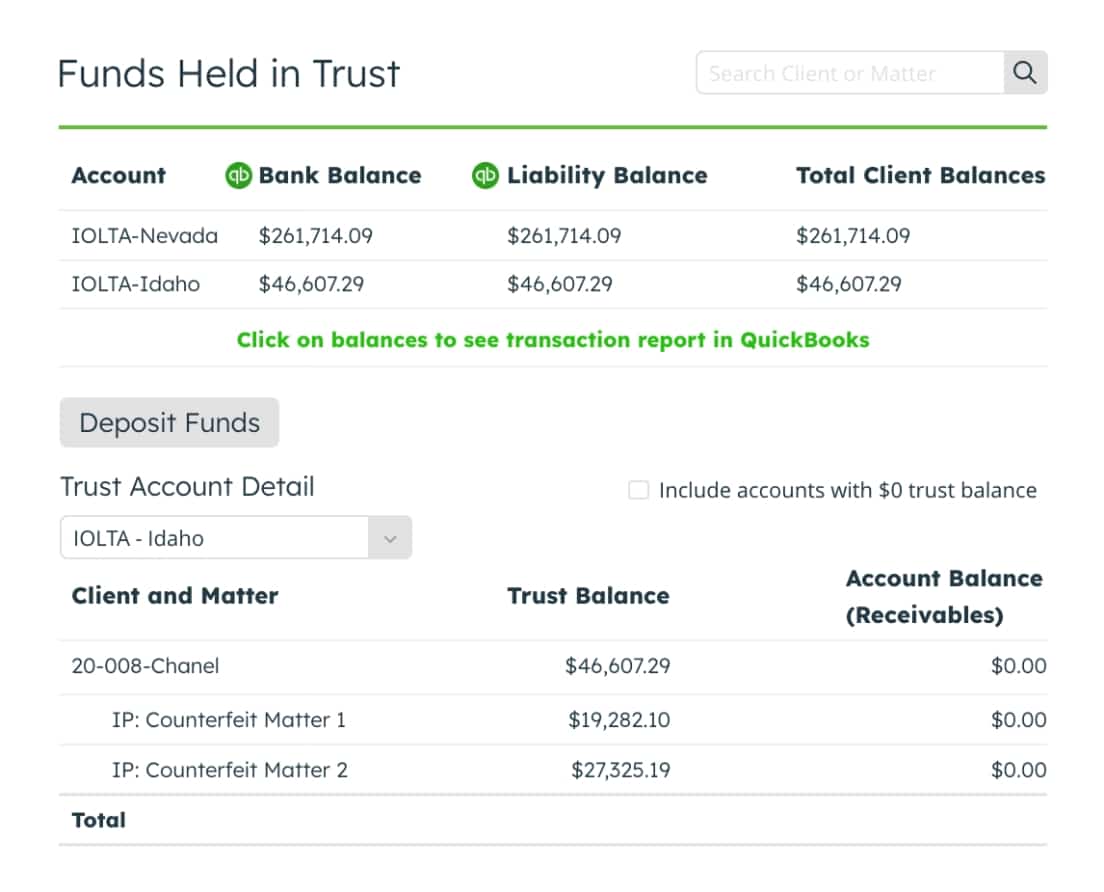

IOLTA inflow and outflow accountability
Request and track IOLTA funds electronically with our Confido Legal integration. Better understand how funds are flowing in and out of trust and bank accounts with convenient, clear reporting. Realize higher accounts receivable. And use memos to communicate transparently with clients.
3. Trust Accounting: LeanLaw includes dedicated trust accounting features that handle client trust deposits and withdrawals, reconcile trust balances, and generate trust account reports. This ensures compliance with IOLTA regulations and state bar requirements.
4. Financial Reporting: LeanLaw offers comprehensive financial reports — profit and loss statements, balance sheets, cash flow statements, and attorney productivity reports. These provide the visibility law firm leaders need to make informed decisions.
5. Integration with Payment Gateways: LeanLaw integrates with popular payment processors, allowing firms to accept online client payments securely and improve cash flow.
6. Data Security and Accessibility: LeanLaw uses data encryption, automated backups, and role-based access controls to protect sensitive financial data. Cloud-based access means authorized users can log in securely from anywhere.
By using LeanLaw’s billing and accounting software, law firms optimize their financial operations, ensure trust accounting compliance, generate meaningful financial reports, and simplify client payments — all while staying focused on their legal work.
From small and mid-sized firms to larger practices, integrating LeanLaw into your cloud-based tech stack demonstrates how purpose-built financial software outperforms a generalist all-in-one system for the functions that matter most.
If you are ready to see what cloud-based billing and accounting built specifically for law firms looks like, request a demo from LeanLaw today.
Get started with LeanLaw
Discover how LeanLaw’s accounting tools automate the trust accounting process in a few simple clicks and get started with your law office.

Published by
The LeanLaw Team
The LeanLaw Team is the legal-finance content team behind LeanLaw — the billing, trust accounting, and revenue-reporting platform built natively on QuickBooks Online. Drawing on years of work alongside law firms and the accountants who serve them, the team writes about trust accounting, IOLTA compliance, legal billing, and law-firm financial operations. LeanLaw is a QuickBooks Online Premium App Partner.
Related articles